
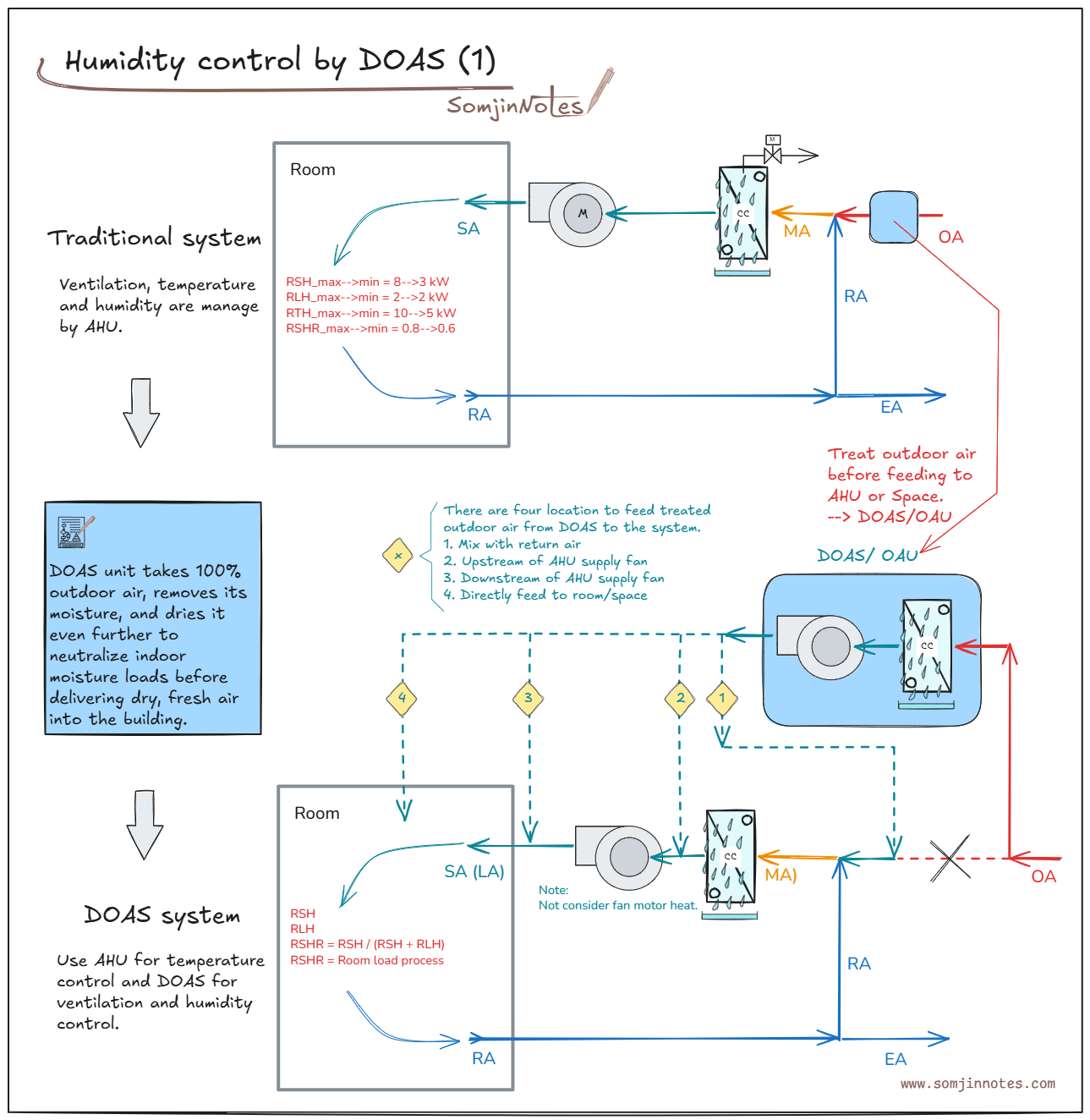
Stop forcing one AHU to do everything
In our last posts, we looked at how traditional systems struggle with humidity at part-load, forcing us to use over-cool and reheat strategies, some are waste amounts of energy.
The root of the problem is that we force a single air handling unit (AHU) to manage ventilation, temperature, and humidity all at once.
To fix this, we can use a Dedicated Outdoor Air System (DOAS) to separate the outdoor air load from the indoor air load.
One common approach is to design the DOAS to deliver air at the exact dew point of the room. But this is only half the story. Because indoor-generated moisture is still left to the main AHU, room humidity will still spike during part-load conditions.
To fully decouple temperature and humidity control, we must lower the DOAS leaving air dew point below the room’s dew point. This allows the dry outdoor air to absorb and offset all indoor humidity loads. Stop relying on the main AHU for humidity control—we know that latent cooling in a standard AHU is just a volatile byproduct of temperature control.
In short, the DOAS unit takes 100% outdoor air, removes its moisture, and dries it even further to neutralize indoor moisture loads before delivering dry, fresh air into the building.
Related notes:
Chilled water cooling coil characteristic
Air conditioning process in summer at partial load condition Part 1 (CAV)
Air conditioning process in summer at partial load condition Part 2 (VAV)
Leave a Reply