
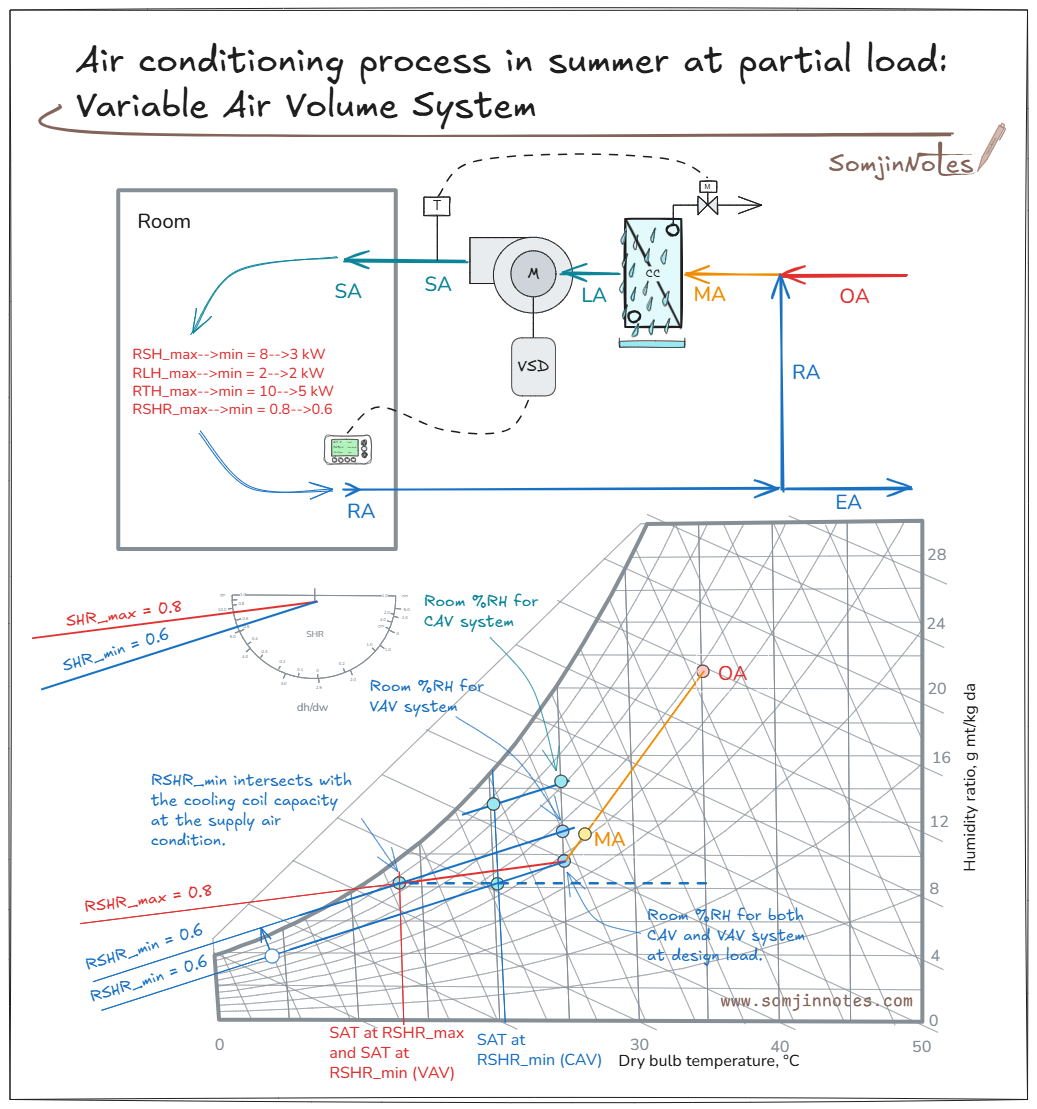
Our previous note illustrated the part-load behavior of a Constant Air Volume (CAV) system. As the cooling load decreases, a CAV system maintains the room temperature via a thermostat, but the room’s relative humidity spikes—often reaching an unacceptable 74%RH. This happens because the chilled water valve throttles down, raising the coil temperature and reducing dehumidification.
To combat this, we can utilize a Variable Air Volume (VAV) system.
Instead of varying the supply air temperature (as a result of keeping constant airflow), a VAV system maintains a constant supply air temperature while varying the airflow (L/s) based on room demand.
Let’s look at the governing equation for Room Sensible Heat (RSH):
RSH = 1.23 x L/s x (Trm – Tsa)
- CAV System Behavior
- Airflow (L/s): Constant
- Room Temperature (Trm): Constant (Thermostat setpoint)
- Result: As RSH decreases, Tsa must increase. The cooling coil gets warmer, reducing its ability to dehumidify.
- VAV System Behavior
- Airflow (L/s): Variables (Modulated by the room thermostat/VAV box). Note: This note illustrate single zone VAV, so using Fan & VSD is enough.
- Room Temperature (Tra): Constant (Thermostat setpoint)
- Supply Air Temperature (Tsa): Constant (Maintained by modulating the cooling coil valve)
- Result: As RSH decreases, the airflow (L/s) decreases proportionally.
The Psychrometric Reality
On a psychrometric chart, because the VAV system maintains a constant, low supply air temperature (Tsa), the cooling coil continues to remove moisture effectively even at part-load. Unlike the CAV system—where the coil warms up—the VAV system keeps the supply air cool & dry. Consequently, the room’s relative humidity remains lower and closer to comfort setpoints than it would under a CAV system.
Note: At extremely low loads, even VAV systems will face humidity spikes, which is why specialized reheat or dedicated outdoor air systems (DOAS) are used for strict humidity control. I will shown later.
Related notes:
Supply air flow control for VAV system
Sequence of operation for VAV AHU
Leave a Reply