
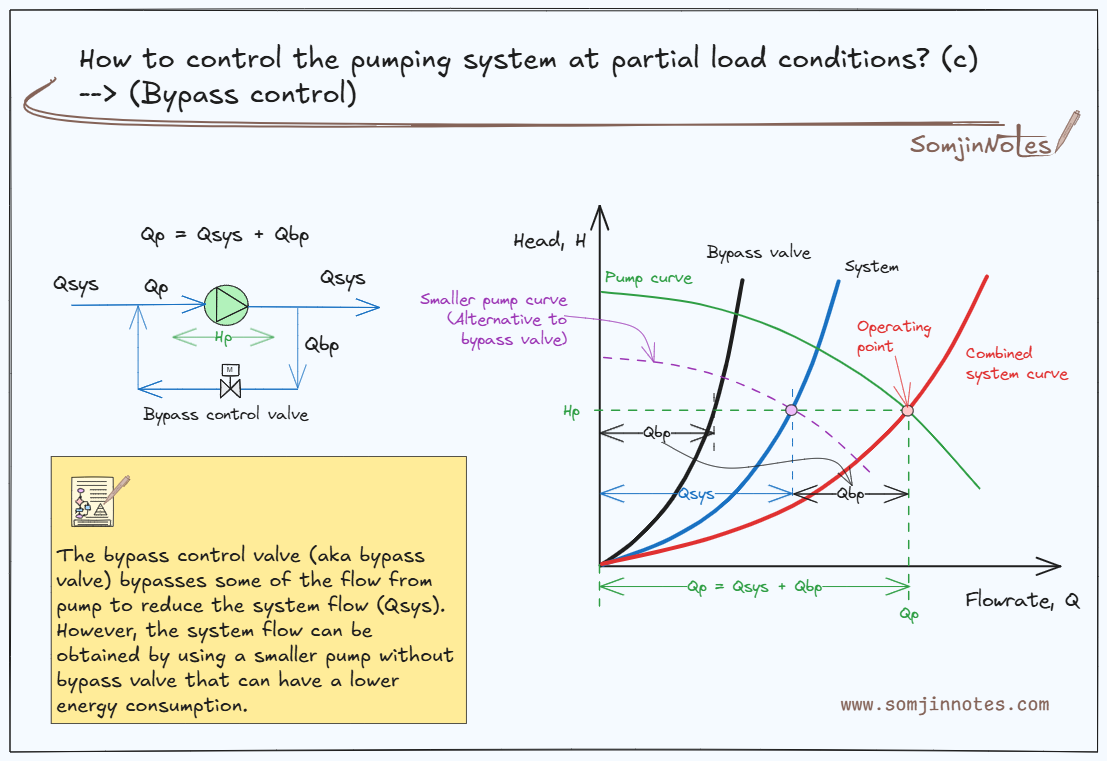
There are two main methods to control a pumping system under partial-load conditions, as stated in the previous note: Pump control in HVAC system – how to?, modulating a control valve and adjusting the pump speed. However, another method commonly encountered in HVAC systems is bypass control.
Instead of modulating a control valve installed in series with the pump, a control valve can be installed in parallel with the pump which known as a bypass valve. This arrangement allows the pump to operate within an acceptable performance range, especially to maintain the minimum allowable flow through the pump.
Bypass control is typically applied when the system flow demand drops below the pump’s minimum flow requirement, which is required to protect the pump from overheating, internal recirculation, or mechanical damage.
Another example is a Variable Primary Flow (VPF) chiller plant. When system demand falls below the minimum flow required by the chiller, operating below the manufacturer’s specified limit can lead to evaporator freezing and potentially damage to the chiller. In such cases, a minimum bypass valve is used to maintain the required minimum flow while satisfying reduced system demand.
Related notes:
Pump control in HVAC system – how to?
Pumping energy comparison at partial load – the basic
System curve – arrangment of multiple component (การรวม System curve แบบขนานและแบบอนุกรม)
System curve – arrangment of multiple component (การรวม System curve แบบขนานและแบบอนุกรม)
Leave a Reply