
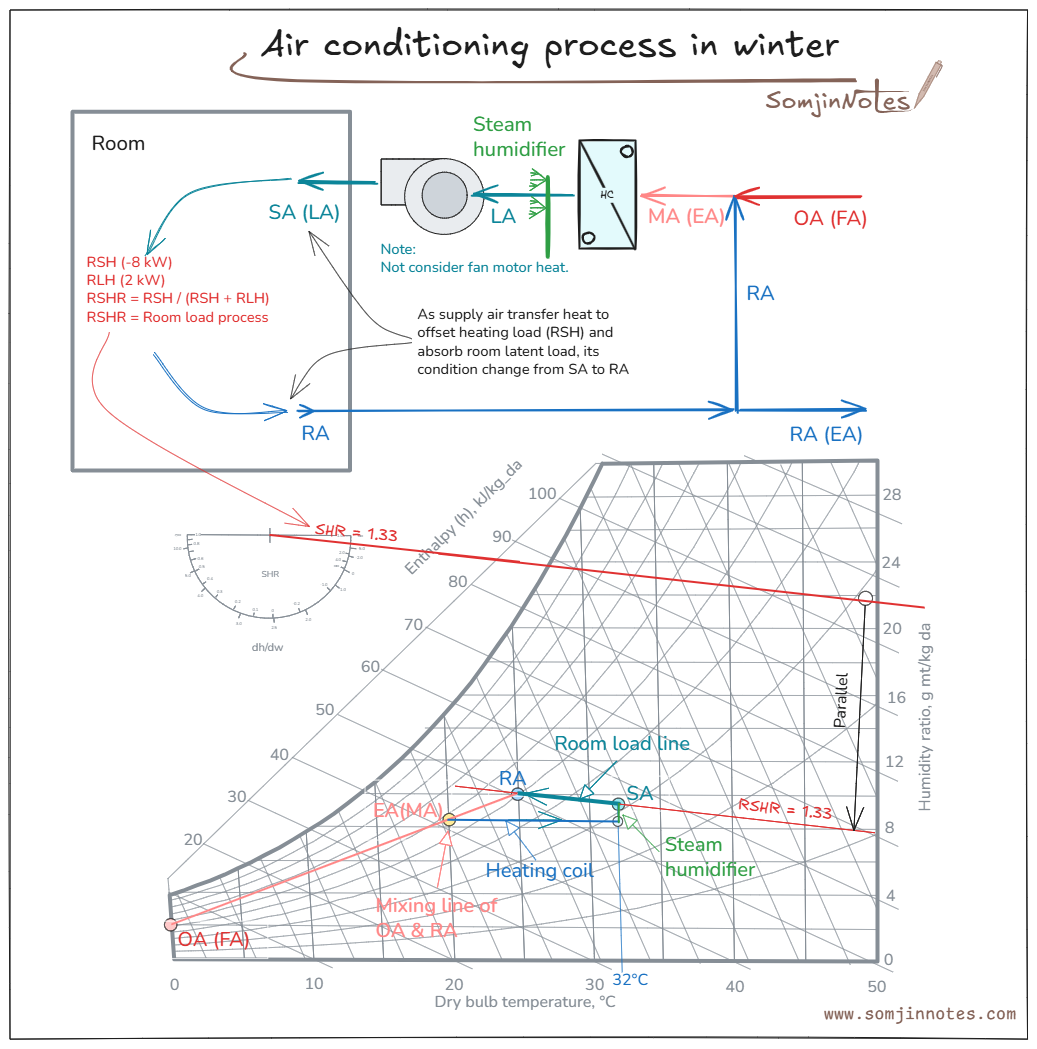
Similar to the summer cycle, the air conditioning process for winter must follow the Room Sensible Heat Ratio (RSHR) line to satisfy space conditions. However, the RSHR is difference, the room faces a sensible heat loss (heating load) coupled with a latent moisture gain from occupants.
This unique combination often results in an RSHR greater than 1.0. For example, RSH = -8 kW, RLH = 2 kW, RTH = -8 + 2 = -6 kW. So RSH = -8/-6 = 1.33.
On the psychrometric chart, this dictates that the Supply Air (SA) state must be warmer and drier than the target Room Air (RA) condition. As the SA enters the room, it loses sensible heat and absorbs internal moisture, moving up and to the left along the RSHR line until it stabilizes at the design RA state.
To achieve this SA state from a cold, dry winter Mixed Air (MA) condition, a heating coil alone is rarely sufficient. While the heating coil raises the dry-bulb temperature, a humidifier must typically be introduced into the air stream to elevate the moisture content to the required supply baseline, ensuring the room does not become excessively dry.
There are two type of humidifiers, water injection and steam injection. This note illustrates the steam humidifier.
Note: This process path assumes a mild winter scenario where the Mixed Air temperature remains safely above freezing, eliminating the need for an outdoor air preheating coil.
Related notes:
Psychrometric process – sensible heating
Psychrometric process – humidification
Psychrometric process – humidification by water injection
Psychrometric process – humidification by steam injection
Leave a Reply