
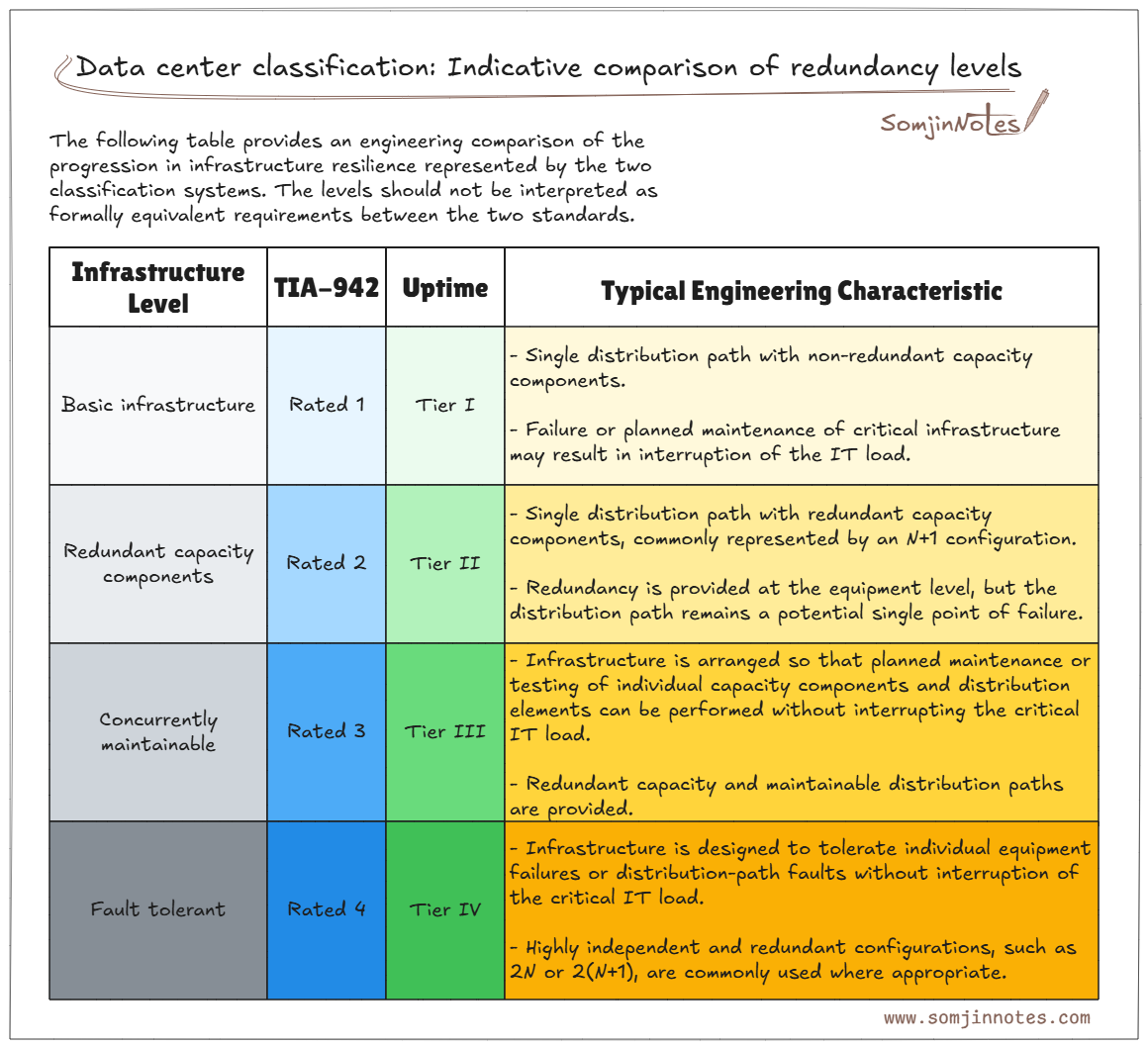
This note provides an engineering comparison of the progression in infrastructure resilience represented by the two classification systems. The levels should not be interpreted as formally equivalent requirements between the two standards.
Key Engineering Considerations
The progression between the classification levels can be understood through four principal engineering characteristics:
- Capacity redundancy: Provision of additional capacity beyond the required design capacity, such as N+1 configurations.
- Distribution-path redundancy: Provision of independent or redundant paths for electrical power, chilled water, or other critical services.
- Concurrent maintainability: Ability to perform planned maintenance on critical infrastructure without interrupting the IT load.
- Fault tolerance: Ability of the infrastructure to withstand a defined single failure without affecting the critical IT load.
It is important to distinguish equipment redundancy from distribution-path redundancy. An N+1 configuration alone does not establish a concurrently maintainable or fault-tolerant data center.
For example, a cooling system may have N+1 chillers or pumps while still relying on a common chilled-water header, valve arrangement, electrical feeder, control system, or other component that could interrupt the entire cooling system. Therefore, the overall system topology, including both capacity and distribution, must be evaluated.
Similarly, configurations such as 2N or 2(N+1) are commonly associated with highly resilient data center designs, but the presence of a particular redundancy configuration alone does not determine the classification. The overall infrastructure topology, maintainability, independence of systems, and response to failure must satisfy the applicable requirements of the selected standard or classification framework.
Accordingly, ANSI/TIA-942 and the Uptime Institute Tier Standard should be regarded as separate frameworks with different scopes and assessment methodologies.
Where a project specifies either framework, the detailed requirements of the applicable standard should be used as the governing basis for design rather than relying solely on a direct Rated-to-Tier equivalence.
Related notes:
Data Center Classification: ANSI/TIA-942 and Uptime Institute
Data center redundancy level – What is N and R ?
Leave a Reply