
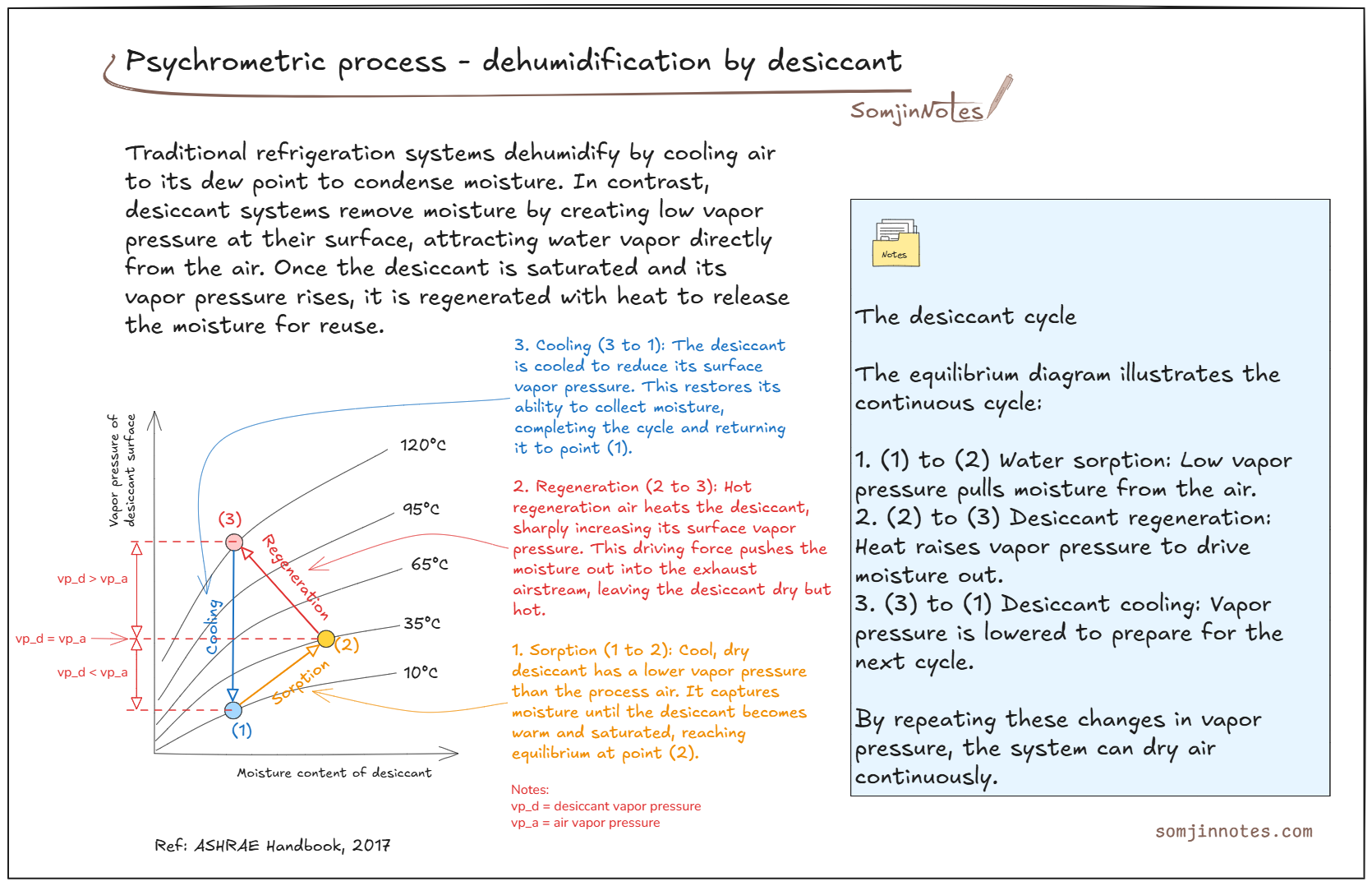
Traditional refrigeration systems dehumidify by cooling air to its dew point to condense moisture. In contrast, desiccant systems remove moisture by creating low vapor pressure at their surface, attracting water vapor directly from the air. Once the desiccant is saturated and its vapor pressure rises, it is regenerated with heat to release the moisture for reuse.
The desiccant process steps are as follows:
- Sorption (1 to 2): Cool, dry desiccant has a lower vapor pressure than the process air. It captures moisture until the desiccant becomes warm and saturated, reaching equilibrium at point (2).
- Regeneration (2 to 3): Hot regeneration air heats the desiccant, sharply increasing its surface vapor pressure. This driving force pushes the moisture out into the exhaust airstream, leaving the desiccant dry but hot.
- Cooling (3 to 1): The desiccant is cooled to reduce its surface vapor pressure. This restores its ability to collect moisture, completing the cycle and returning it to point (1).
By repeating the changes in vapor pressure, the system can dry air continuously.
What’s Next?
Now that we understand the basic “Sorption-Regeneration-Cooling” cycle, it is important to look at the two different ways we can put this theory into practice. Depending on the application, engineers choose between two main types of systems:
- Solid Desiccants: How materials like silica gel use surface area to “adsorb” moisture.
- Liquid Desiccants: How salt solutions “absorb” water vapor for high-efficiency cooling.
In the next sections, I will dive deep into how each one works.
Leave a Reply